In medical manufacturing, contamination control has always been a fundamental production requirement. But in 2026, the standard for what constitutes adequate contamination control in clean room injection environments has shifted significantly. Medical device buyers, regulatory auditors, and quality management teams are no longer satisfied with clean rooms that simply control airborne particles and environmental conditions — they are demanding production processes that systematically eliminate the contamination risks that environmental controls alone cannot address.
The most significant of those risks is human contact. In a well-managed clean room, the environmental parameters — air cleanliness, temperature, humidity, pressure differentials, and material flow — can be controlled to a high standard. But human operators remain one of the largest and most variable sources of contamination in any clean room production environment. Skin particles, hair and fiber fragments, glove contact residue, clothing friction, manual part transfer errors, and movement between production zones all introduce contamination risks that environmental controls cannot fully mitigate. For medical grade silicone injection molding — where biocompatibility, surface purity, dimensional consistency, and batch traceability are all critical to product safety and regulatory compliance — even small contamination events can affect inspection outcomes, downstream assembly, sterilization performance, and customer approval.
Packson addresses this challenge by integrating robotic arms, automated conveyors, in-line inspection systems, and automatic packaging into a clean room injection production model that minimizes direct human contact with molded parts from the moment they leave the mold to the moment they are sealed in clean packaging. This guide covers the complete picture for medical device procurement and manufacturing teams: why human contact is the contamination risk that clean room environmental controls cannot solve, what clean room injection and medical grade silicone injection molding involve, how automation systems work together to create a touchless manufacturing process, how automated clean room molding compares to manual and semi-automated alternatives, and what procurement and maintenance practices protect clean room production efficiency and purity over the long term. Secondary keywords relevant to this decision — automated clean room molding, robotic injection molding for medical, touchless manufacturing process, and clean room production efficiency — are addressed throughout.
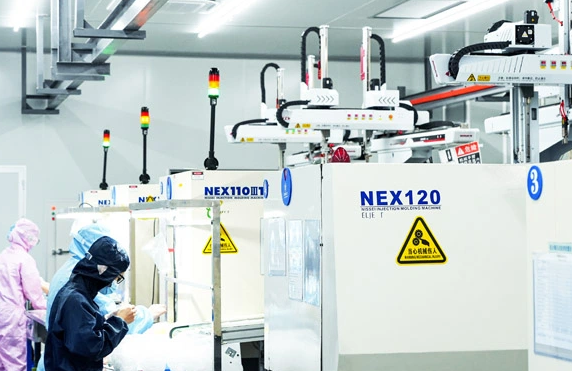
The business case for investing in automated clean room injection starts with a clear understanding of why human operators — even properly gowned, trained, and supervised operators working in a well-managed clean room — remain a significant and difficult-to-control contamination source in medical component production.
A human operator working in a clean room generates a continuous stream of contamination regardless of the protective measures in place. The human body sheds approximately 30,000 to 40,000 skin cells per hour under normal conditions — a rate that increases with physical activity. Clothing generates fiber particles through friction and movement. Gloves, while essential for preventing direct skin contact, can themselves generate particles through wear and can transfer surface contamination from one part or surface to another. Breathing generates aerosol particles that can settle on product surfaces. And the movement of operators between production zones creates air currents that can disturb settled particles and carry them toward product surfaces.
For medical grade silicone injection molding, these contamination risks are particularly significant because silicone surfaces have a natural tendency to attract and retain particles through electrostatic attraction. A silicone component that passes through multiple manual handling steps — mold removal, transfer to inspection, transfer to packaging — accumulates contamination risk at each step. And because silicone medical components are often used in applications where biocompatibility and surface purity are critical — respiratory care, drug delivery, implantable devices, diagnostic systems — contamination that is not detected during production can have serious consequences for patient safety.
The contamination control requirements that medical device buyers are specifying in 2026 reflect a clear direction: less human contact, more automation, better documentation, and more consistent quality across large production volumes. Buyers are demanding lower defect rates supported by statistical process control data, more stable quality documentation that demonstrates process consistency rather than just end-product inspection results, reduced manual handling steps that can introduce contamination variability, traceable production data that links every part to its production parameters, and consistent large-volume output that can support global supply chain requirements. These demands are driving the adoption of automated clean room molding as the production standard for high-purity medical components.
Understanding what clean room injection is — and what medical grade silicone injection molding specifically requires — is essential context for evaluating the automation investment needed to achieve the contamination control standards that 2026 medical device production demands.
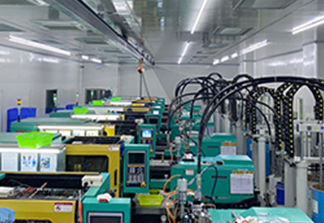
Clean room injection refers to injection molding performed in a controlled clean room environment where airborne particles, personnel movement, equipment layout, material flow, and product handling are all managed to reduce contamination risk. The critical distinction is that clean room injection is not simply "molding inside a clean room" — it is a complete production system that integrates controlled environment management, precision tooling, validated processes, automation, inspection, and packaging into a coherent contamination control strategy.
The clean room classification — ISO Class 7, ISO Class 8, or other standards depending on the application — defines the maximum allowable particle concentration in the production environment. But the clean room classification alone does not determine the contamination level of the finished product. The handling, transfer, inspection, and packaging steps that occur after molding are equally important — and these are the steps where human contact introduces the most significant contamination risk.
Medical grade silicone injection molding is the process of molding medical-grade liquid silicone rubber or solid silicone material into precision components used in healthcare, diagnostics, respiratory care, surgical devices, drug delivery, and other medical applications. The material requirements for medical-grade silicone are significantly more demanding than for industrial silicone: biocompatibility certification, extractables and leachables testing, lot-to-lot consistency, and compliance with relevant pharmacopeial standards are all required for components that will contact patients or be used in medical devices.
The process requirements for medical grade silicone injection molding are equally demanding: precise injection pressure and temperature control, accurate curing time management, tight dimensional tolerances, smooth surface quality, low contamination risk throughout the production process, consistent batch traceability, and reliable quality documentation. These requirements make the contamination control provided by automated clean room injection not just a quality preference but a production necessity.
Clean room injection and medical grade silicone injection molding are used to produce: medical silicone seals and gaskets, respiratory mask components, catheter-related parts, medical valves, diagnostic device components, drug delivery system parts, wearable medical device components, surgical instrument parts, medical connector components, and healthcare monitoring device parts — all applications where surface purity, dimensional consistency, and batch traceability are critical to product safety and regulatory compliance.
The automation architecture of a fully automated clean room injection production cell is not a single technology — it is a coordinated system of robotic handling, automated transfer, in-line inspection, and automatic packaging that works together to minimize human contact at every step between mold opening and final packaging.
Automated material feeding is the first step in reducing human contact with the production process. Medical-grade silicone material is supplied through controlled feeding systems — closed material handling that prevents manual exposure and maintains material consistency from lot to lot. Controlled material feeding also supports the process documentation requirements of medical device manufacturing by providing traceable material input data for each production batch.
Precision injection and molding is the core production step where the injection molding machine controls pressure, temperature, curing time, and mold movement to produce stable, consistent parts. In medical grade silicone injection molding, the precision of this step determines the dimensional consistency, surface quality, and curing performance of the finished component — and the stability of the process window determines whether these properties are maintained consistently across long production runs.
Robotic part removal is the automation step that most directly reduces human contact with molded parts. A robotic arm removes molded silicone components directly from the mold immediately after the mold opens — eliminating the manual part removal step that is one of the highest contamination risk points in conventional clean room production. The robotic arm uses end-of-arm tooling specifically designed for the part geometry to hold components safely without deformation, surface damage, or contamination transfer. Robotic injection molding for medical applications requires careful end-of-arm tooling design — silicone components are often soft, flexible, and easily deformed, and the tooling must handle them without applying stress that could affect dimensional accuracy or surface integrity.
Automated conveyor transfer moves parts through the clean room production zones between molding, inspection, and packaging without manual handling. Automated conveyors eliminate the manual tray handling and part transfer steps that introduce contamination risk and handling damage in conventional production. The conveyor system design must be compatible with the clean room environment — using materials and surface finishes that do not generate particles, and operating at speeds that do not create air currents that could disturb the clean room environment.
In-line inspection uses vision inspection systems or automated measurement equipment to check surface defects, shape consistency, flash, short shots, and dimensional issues on every part as it moves through the production cell. In-line inspection provides 100 percent inspection coverage without the manual handling that conventional sampling inspection requires — and generates the statistical process control data that medical device buyers increasingly require as evidence of production consistency.
Automatic packaging transfers approved parts into clean packaging with minimal human contact, preserving the cleanliness achieved through the upstream automation steps. Automatic packaging systems can be configured to produce individual part packaging, bulk packaging, or sterile-ready packaging depending on the downstream requirements of the medical device assembly or sterilization process.
| Automation Component | Function | Contamination Control Value |
|---|---|---|
| Robotic arm | Removes parts from mold | Eliminates highest-risk manual handling step |
| End-of-arm tooling | Holds silicone parts safely | Prevents deformation and surface damage |
| Automated conveyor | Transfers parts between stations | Removes manual tray handling contamination risk |
| Vision inspection system | Checks defects and consistency | Provides 100% inspection without manual contact |
| Automatic packaging system | Packs parts with minimal handling | Preserves cleanliness before sterilization or assembly |
| Process sensors and monitoring | Tracks machine and process data | Supports traceability and process validation |
| Controlled workcell layout | Separates zones and workflows | Maintains clean room discipline and airflow management |
The selection of the appropriate production model for a clean room injection project involves evaluating the contamination control requirements, production volume, part complexity, and total cost of ownership across the available automation levels — and understanding where fully automated clean room molding provides the strongest combination of purity, consistency, and production economics.
Fully automated clean room injection provides the strongest contamination control, the most consistent production quality, and the best production economics for high-volume medical component manufacturing. By eliminating direct human contact with parts from mold removal through packaging, it addresses the contamination risk that environmental controls alone cannot solve. The higher upfront investment in robotic handling, automated conveyors, in-line inspection, and automatic packaging is justified by lower contamination risk, lower defect rates, better process documentation, and lower labor cost per unit at production scale.
Semi-automated clean room injection retains some manual handling steps — typically part inspection or packaging — while automating the highest-risk steps such as mold removal and transfer. It provides better contamination control than fully manual production and is appropriate for medium-volume projects where the full automation investment is not yet justified by production volume.
Manual clean room molding is appropriate for small batches, early prototypes, and design validation — where flexibility and lower initial setup cost are more important than contamination control consistency. It is not appropriate for high-volume medical component production where contamination consistency and process documentation are critical requirements.
Robotic injection molding for medical applications — specifically the integration of robotic part removal with the injection molding machine — is the most impactful single automation step for contamination control, because mold removal is the highest-risk manual handling step in conventional clean room production. Even in production cells that retain some manual steps downstream, robotic mold removal significantly reduces the contamination risk compared with manual part removal.
| Production Model | Contamination Control | Production Consistency | Best Application |
|---|---|---|---|
| Fully automated clean room injection | Maximum | Highest | High-volume medical components, critical purity requirements |
| Semi-automated clean room injection | Good | Good | Medium-volume production, transitional automation |
| Manual clean room molding | Limited | Variable | Prototypes, low volume, design validation |
| Robotic injection molding for medical | High for mold removal step | High for handled steps | High-precision silicone parts, deformation-sensitive components |
Automated clean room injection delivers the most value for manufacturers of medical components where surface purity, dimensional consistency, and batch traceability are all critical: medical device manufacturing for implantable and patient-contact applications, diagnostic and testing device production where contamination could affect assay accuracy, respiratory care component manufacturing where surface cleanliness affects patient safety, drug delivery system components where extractables and leachables requirements demand maximum material purity, wearable healthcare device components where long-term skin contact requires biocompatibility assurance, surgical instrument components where sterility assurance is a regulatory requirement, and laboratory consumables where contamination could affect research or diagnostic results.
Selecting a clean room injection partner for medical grade silicone injection molding requires systematic evaluation of both the supplier's automation capability and their clean room management discipline — and ongoing maintenance practices that protect clean room production efficiency and contamination control performance over the production program's lifetime.
Before selecting a clean room injection partner, buyers should confirm the following:
Confirm the clean room classification available — ISO Class 7, ISO Class 8, or other — and verify that it meets the contamination control requirements of the specific medical component application
Confirm that the production process is validated for medical grade silicone injection molding — including material biocompatibility, process parameter validation, and quality documentation capability
Confirm robotic part removal capability — verify that the supplier has experience designing end-of-arm tooling for silicone components and can demonstrate that robotic handling does not cause deformation, surface damage, or dimensional distortion
Confirm automated conveyor capability — verify that the conveyor system is clean room compatible and does not generate particles or create air currents that could affect clean room classification
Confirm in-line inspection capability — verify that the vision inspection system can detect the defect types relevant to the specific component and that inspection data is recorded for process documentation
Confirm automatic packaging capability — verify that the packaging system can produce the packaging format required for downstream sterilization, assembly, or shipment
Confirm process parameter recording and traceability — verify that the production system records injection pressure, temperature, curing time, and other critical parameters for each production batch
Confirm quality documentation capability — IQ, OQ, PQ validation documentation, material traceability records, inspection data, and batch records for medical device regulatory requirements
Confirm contamination control procedures — gowning requirements, personnel movement protocols, equipment cleaning schedules, and environmental monitoring programs
Confirm mass production capacity — verify that the supplier can support the required annual volume with the automation level needed for the contamination control requirements
Request a facility visit or virtual tour to verify clean room conditions, automation integration, and production discipline before committing to a production program
Clean robotic arms, end-of-arm tooling, and grippers according to the scheduled maintenance program — contamination buildup on robotic components can transfer to parts during handling
Inspect end-of-arm tooling for wear, particle generation, or surface degradation at each maintenance interval — worn tooling can generate particles or cause part deformation that affects quality
Keep conveyors free from dust, oil, and debris — conveyor surfaces that contact parts must be maintained to the same cleanliness standard as the clean room environment
Validate automatic packaging system cleanliness regularly — packaging that introduces contamination at the final production step negates the contamination control achieved upstream
Monitor clean room environmental parameters — air particle counts, temperature, humidity, and pressure differentials — continuously and respond to excursions before they affect production
Use only clean room-approved lubricants for moving components — standard lubricants can generate particles or vapors that contaminate the clean room environment
Minimize unnecessary manual intervention during automated production runs — each manual intervention introduces a contamination risk that the automation system is designed to eliminate
Maintain mold surfaces and part-contact areas to the cleanliness standard required for medical-grade production — mold contamination transfers directly to part surfaces
Keep batch records, inspection data, environmental monitoring records, and maintenance logs for regulatory compliance and customer audit purposes
Revalidate automation systems after any tooling change, equipment repair, or process parameter modification — changes to the production system can affect contamination control performance and require revalidation before production resumes
In 2026, medical manufacturers need more than clean rooms — they need clean processes. Because human contact is one of the largest and most variable contamination risks in any clean room production environment, automation has become the most powerful available tool for achieving the contamination control consistency that medical device buyers, regulatory auditors, and patient safety requirements demand. By integrating robotic arms, automated conveyors, in-line inspection, and automatic packaging into a coordinated touchless manufacturing process, clean room injection can simultaneously improve contamination control, production consistency, process documentation quality, and production economics — delivering the combination of purity and scalability that high-volume medical component manufacturing requires.
For companies developing silicone medical components, Packson's medical grade silicone injection molding capabilities — combined with automated clean room molding integration, precision mold design, and application-specific engineering support — provide a path to cleaner, more consistent, and more cost-effective medical component production. With experience in clean room production, robotic injection molding for medical applications, and quality documentation for medical device regulatory requirements, Packson supports medical manufacturers who need to build a production process that meets the contamination control standards of 2026 and beyond.
Contact Packson today to discuss your clean room injection project requirements, medical silicone material specifications, automation goals, production volume targets, part design, and packaging needs. The Packson team can help evaluate the right combination of clean room classification, automation level, and process validation to build a cleaner, more efficient, and more scalable molding solution for your medical device components.
Q1: What is clean room injection and how does it differ from standard injection molding?
Clean room injection is injection molding performed in a controlled clean room environment where airborne particles, personnel movement, material flow, and product handling are all managed to reduce contamination risk. It differs from standard injection molding in its environmental controls, personnel protocols, automation integration, and quality documentation requirements — all designed to meet the contamination control standards required for medical and high-purity component production.
Q2: Why is automation important in clean room injection for medical components?
Human operators are one of the largest contamination sources in any clean room environment, generating skin particles, fiber fragments, and handling-related contamination regardless of protective measures. Automation — robotic part removal, automated conveyors, in-line inspection, and automatic packaging — reduces direct human contact with parts, lowering contamination risk and improving production consistency simultaneously.
Q3: What is medical grade silicone injection molding and what products does it produce?
Medical grade silicone injection molding is the process of molding medical-grade silicone materials into precision components for healthcare applications — including seals, gaskets, respiratory mask components, catheter parts, medical valves, drug delivery components, wearable device parts, and surgical instrument components. It requires biocompatible materials, tight dimensional tolerances, smooth surface quality, and rigorous contamination control throughout the production process.
Q4: How does robotic injection molding for medical parts improve contamination control?
Robotic part removal eliminates the manual mold removal step — one of the highest contamination risk points in conventional clean room production. Robots remove and transfer parts consistently without skin contact, fiber generation, or handling variability, reducing contamination risk and part damage simultaneously while generating consistent process data for quality documentation.
Q5: What should buyers check before choosing a clean room injection supplier for medical silicone components?
Buyers should check clean room classification, medical silicone molding experience, robotic handling capability, conveyor and packaging automation, in-line inspection systems, contamination control procedures, process parameter recording and traceability, quality documentation capability including validation support, mass production capacity, and the supplier's track record with comparable medical device component projects.

Contact Us
 English
  日本語
日本語  Deutsch
  Español